Led Zeppelin, IV
Led Zeppelin LED ZEPPELIN IV.
Eight songs, no printed album title and no band name on the original front cover. Led Zeppelin's fourth record turned studio experimentation, folk music, hard rock and one enormous staircase into one of the defining albums of the era.
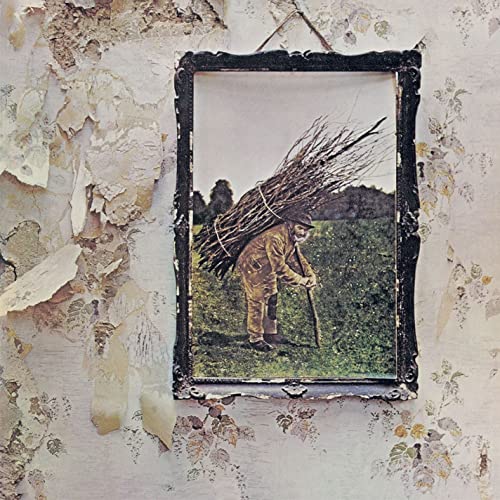
Album artwork shown for commentary and historical reference. Image source: Led Zeppelin official discography.
SEVEN THINGS
WORTH KNOWING.
The record sounds unified, but it was built across studios, a country house and a mixing process that did not go nearly as smoothly as planned.
Led Zeppelin IV was released on November 8, 1971, contains eight tracks and was produced by Jimmy Page.
The album was officially untitled, with no band name or album title on the original front cover, while four symbols chosen to represent the band members appeared inside the package.
Recording began at Island Studios in London in November 1970 before major sessions moved to Headley Grange in Hampshire using the Rolling Stones Mobile Studio.
An early version of "When the Levee Breaks" called "If It Keeps On Raining" was recorded at Island Studios, but the final album version was recorded later at Headley Grange.
Jimmy Page and engineer Andy Johns mixed much of the album at Sunset Sound in Hollywood, but most of those mixes were rejected, leaving "When the Levee Breaks" as the Sunset Sound mix retained for the original album.
"Stairway to Heaven" ran seven minutes and fifty-five seconds, yet Led Zeppelin's own 1976 press material noted that the song received widespread radio play as an album cut.
More than fifty years after the album appeared, researchers traced the man on the cover to a late Victorian photograph of Wiltshire thatcher Lot Long, likely taken by photographer Ernest Farmer.
WHY THIS
ALBUM MATTERS.
Led Zeppelin IV refuses to choose between extremes. "Black Dog" and "Rock and Roll" sit beside the acoustic "Going to California," while "Stairway to Heaven" moves through several different musical identities inside one song.
The Recording Academy inducted the album into the Grammy Hall of Fame in 1999, followed by "Stairway to Heaven" as an individual recording in 2003.
THE
NUMBERS.
TRACKS
The entire original album contains only eight songs.
STAIRWAY
The song became a major radio staple despite its unusually long running time.
GRAMMY HALL OF FAME
The Recording Academy inducted Led Zeppelin IV into the Grammy Hall of Fame.
THE
PHYSICAL OBJECT.
The original package famously avoided putting the band's name or an album title on the front cover.
Instead, the sleeve shows a framed image of an elderly man carrying sticks hanging on a damaged wall, while the gatefold expands the image into a contrast between rural and urban life.
The mystery lasted for decades. Research announced in 2023 traced the source image to a Victorian photograph of Lot Long, a Wiltshire thatcher, found inside an old photograph album.
RESEARCH SOURCES
Facts are checked against the band's official archive, recording documentation, the Recording Academy and historical research into the album artwork.
KEEP
DIGGING.
More recording stories, strange credits, cover art, chart numbers and details hiding inside the records.